MCP: AI Is No Longer an Island—Connecting Models to Tools
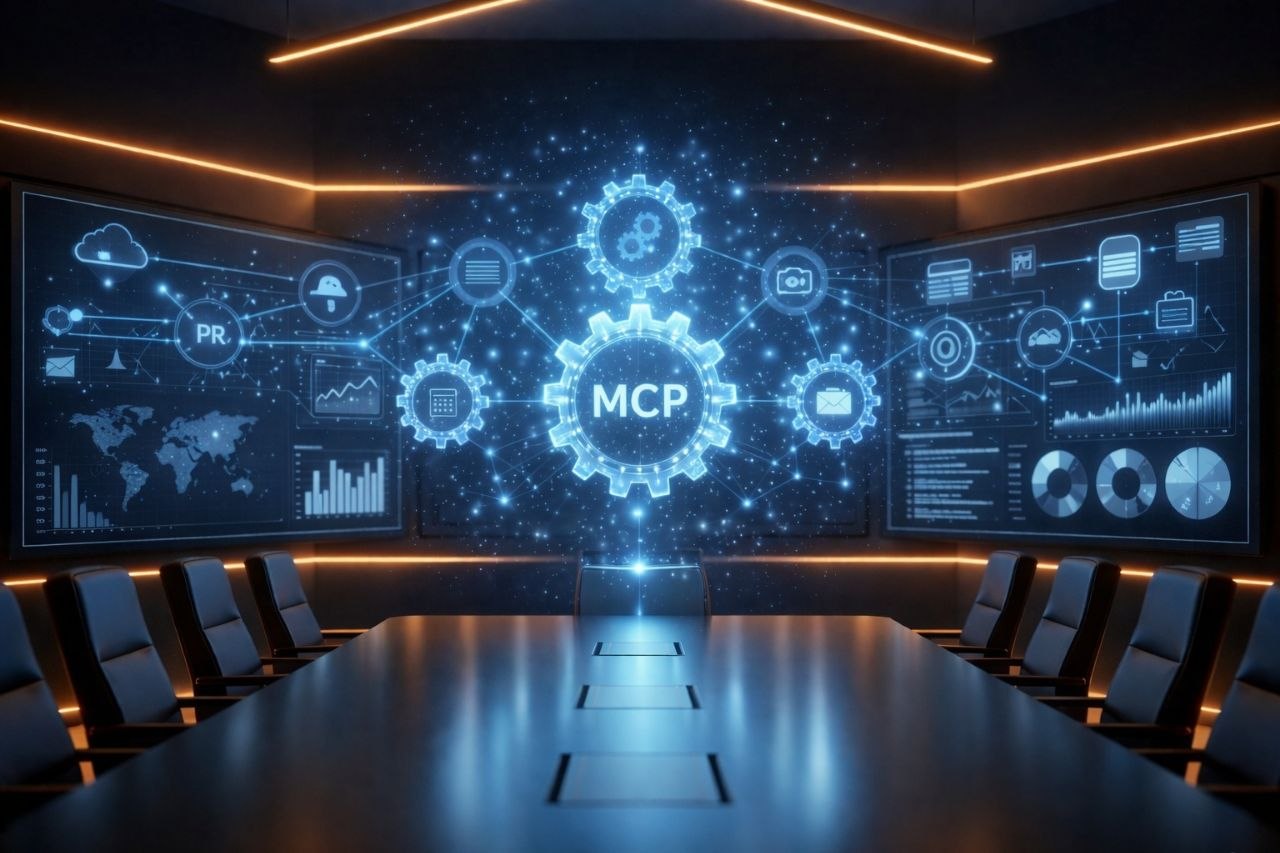
MCP, the Model Context Protocol, is a standard that gets AI out of its isolation and into the real world. Not magic. Just order. Define MCP connectors, and you expose concrete capabilities: reading data, executing actions, and querying statuses. The model, instead of improvising, learns to use them.
MCP: the AI “USB” for modern tooling
MCP is a standard protocol to connect models to external tools, data, and services. It’s not magic. It’s organization. Instead of wiring everything by hand, you define MCP connectors. These expose explicit capabilities: read data, execute actions, check statuses. And the model, instead of improvising, knows how to use them.
All of a sudden, AI stops being just a text generator and becomes an agent that can interact with real systems.
The human side: the human-centric value of MCP
MCP’s value isn’t in the architecture; it’s in the capabilities it provides to the team.
Because it changes the relationship between you and AI.
Before:
- You asked for something.
- It returned a response.
- You did the real work.
Now:
- You give context.
- You give access.
- And it starts collaborating with you.
That has a curious effect: AI stops feeling like a tool and starts to resemble a coworker. Not because it thinks, but because it acts inside your own environment.
A simple example (but revelatory)
Imagine you have:
- Azure DevOps with your tickets
- Freshdesk with support
- A code repository full of code
- Production metrics
Without MCP, all of this is separate. You’re the glue.
With MCP, you can have something like:
“Review open high-priority tickets, cross-check with recent production errors, and tell me if any are already resolved in the latest commit.”
That isn’t a pretty prompt. It’s a complex action that crosses real systems.
And the important part: you don’t have to program it every time.
The true shift: fewer interfaces, more intention
We’re used to interfaces: dashboards, panels, buttons.
MCP pushes in another direction: working by intention.
You don’t open five tools. You don’t navigate ten menus. You express what you want and the system, via AI, executes.
It doesn’t remove tools. It unifies them.
Does this replace developers?
No. But it changes their role.
Less time wiring repetitive pieces. More time designing how they should interact.
MCP doesn’t remove complexity. It encapsulates it.
And that, for a technically minded person, is gold. Because it lets you focus on what matters: architecture, decisions, product.
The trap to avoid
Like any promising technology, MCP carries a clear risk: using it without criteria.
Connecting everything “because we can” creates systems that are hard to control. More surface area for error, more dependence on AI, more opacity.
The value isn’t in connecting everything. It’s in connecting the right things.
Where this is headed
If you look at the trend, the path is pretty clear: AI won’t stay a chat tool.
It’s evolving into an orchestration layer.
A layer that understands human language, but also systems, data, and actions.
MCP is one of the first serious steps in that direction.
It’s not the end of the road. But it is a mental shift.
There’s something almost ironic about all this. For years we built software so humans adapted to machines. Interfaces, rules, flows.
Now we’re building the opposite: systems where machines adapt to how we think.
And MCP, at its core, is about that.
OUTBOUND LINKS (EN):